China has become a major sourcing destination for Car Seat Hook manufacturers and suppliers. Its industrial base supports metal stamping, injection molding, surface finishing, and custom assembly. However, supplier selection requires more than comparing online prices. A reliable partner should explain material grades, load testing, production controls, and packaging details clearly.
This guide introduces leading Chinese manufacturers and suppliers serving automotive accessory brands, distributors, and private-label buyers. Their capabilities may include stainless steel hooks, reinforced nylon designs, adjustable straps, and OEM packaging. Buyers should review factory experience, sample consistency, inspection records, and communication speed. A professional supplier can provide drawings, prototypes, test reports, and traceable batch information. These details make quality easier to verify.
Safety remains central. A Car Seat Hook should match its stated application and must not replace a certified child restraint or vehicle safety system. Buyers should confirm dimensions, attachment methods, corrosion resistance, and mechanical strength before placing bulk orders. Independent testing may also be appropriate for specific markets and vehicle models. A polished catalog proves little. Samples reveal more. No supplier is perfect, and even experienced factories can miss a tolerance or packaging requirement. Clear specifications and written approvals reduce that risk. This overview focuses on practical sourcing evidence, manufacturing expertise, and dependable cooperation. It also encourages buyers to question impressive claims, inspect production conditions, and compare total value rather than unit cost alone. These steps support safer purchasing decisions and longer-term supplier relationships.
Car seat hooks are small interior accessories fixed around a vehicle headrest. They create a hanging point for handbags, shopping bags, backpacks, or lightweight travel items. Most designs use a strap, metal loop, or molded plastic body. Installation usually takes less than one minute. The hook slides onto the headrest posts or wraps around the seat structure.
In daily driving, a hook keeps bags off the floor and reduces shifting during turns. It can also protect delicate items from crushed corners and spilled liquids. However, it is not a child-restraint device. It should never replace an approved child seat or support a heavy object.
The National Highway Traffic Safety Administration recorded 3,308 distracted-driving deaths in 2022. A hook may improve cabin organization, but it cannot remove every driving distraction. This distinction matters.
Tips:
Check the supplier’s stated load limit before use. Keep the hook behind the front seat, away from airbags and seat-belt paths. Use it for light bags only. A water bottle or laptop may seem harmless, yet sudden braking changes the risk. Inspect stitching, screws, and plastic edges each month. If the headrest feels loose, stop using the accessory. Fit can be imperfect across different seat designs, so test it gently before regular use.
Car seat hooks are small, but their safety role is substantial. NHTSA recorded 1,129 children under 14 killed in traffic crashes in 2022. Reliable attachment hardware matters. ISO 13216 describes rigid anchorage systems, including lower connectors and top-tether hooks. Lower-anchor hooks usually use stamped or forged high-strength steel. They need controlled geometry, smooth edges, and stable load transfer. Top-tether hooks often have a claw-shaped profile. The opening must resist accidental release during sudden deceleration.
Material selection changes both safety and durability. High-carbon or boron-alloy steel offers strong tensile performance after heat treatment. Stainless steel resists corrosion in humid interiors, but it can cost more. Engineering plastics, such as glass-fiber-reinforced nylon, suit protective covers and secondary hooks. They reduce noise and prevent scratches. However, plastic should not replace load-bearing metal without validated testing. A hook can look simple. It is not. Some suppliers still focus too heavily on appearance and overlook tolerance drift, coating thickness, or repeated-use fatigue.
Tips: Ask suppliers for material certificates, hardness results, salt-spray data, and cyclic load-test records. Check whether each hook matches the intended anchorage geometry. A polished finish proves little. In practical inspections, feel for burrs, uneven plating, and weak spring return. The Global Automotive Research Institute’s component testing guidance emphasizes traceability and repeatable validation, not visual inspection alone. One overlooked weakness is packaging: loose hooks can strike nearby trim during transport, causing damage before installation.
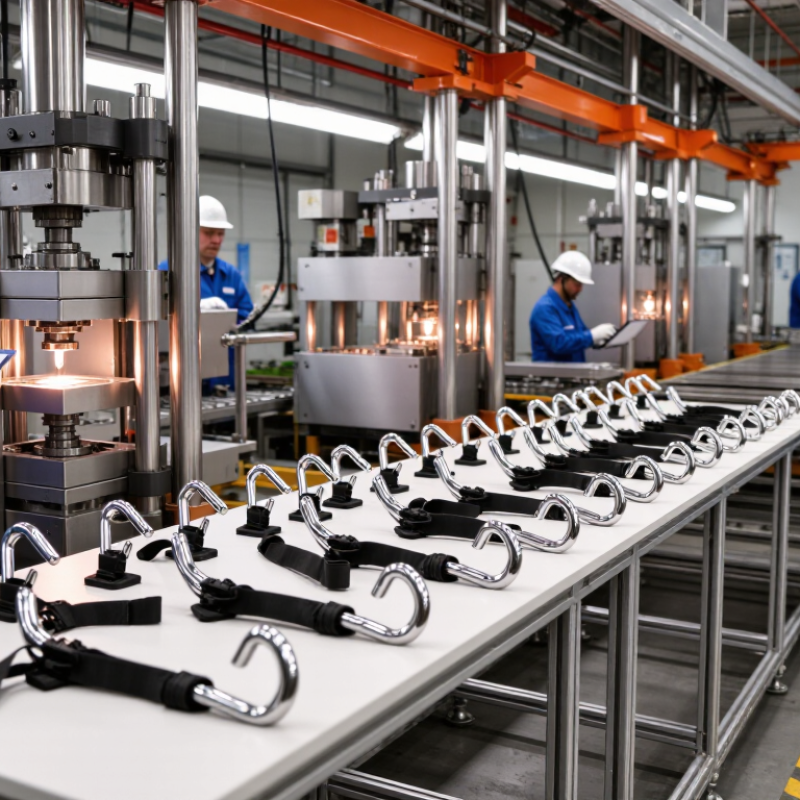
China’s car seat hook production combines metal forming, precision machining, and controlled surface treatment. The China Association of Automobile Manufacturers reported 30.16 million vehicles produced in 2023. This scale supports specialized suppliers, automated presses, and stable material purchasing. Most hooks begin with carbon steel, stainless steel, or zinc alloy. Engineers select the material according to load, corrosion, and installation requirements.
A typical process starts with coil cutting or blanking. Progressive stamping then forms the hook profile and mounting points. Forged parts may receive secondary machining for tighter dimensions. Manufacturers inspect hole diameter, bend angle, burrs, and surface finish. A single sharp edge can damage nearby fabric. It can also weaken assembly performance. Not every factory solves this equally well.
Reliable suppliers usually combine tensile testing, cyclic loading, salt-spray evaluation, and batch traceability. ISO 16750 provides useful environmental testing guidance for road-vehicle components. Customer programs may also reference anchorage requirements under UN vehicle regulations. Production teams record die maintenance, heat-treatment results, and coating thickness. Statistical process control helps identify drift before shipment. Yet visual inspection remains too common in some workshops. That deserves scrutiny. A professional supplier should provide inspection records, sample approval, and corrective-action evidence, not only attractive samples.
Evaluating Chinese car seat hook manufacturers requires more than comparing online prices. Start with a clear drawing, material requirements, dimensions, and intended vehicle use. Specify the hook’s load direction, surface finish, stitching points, and packaging needs. A reliable supplier should explain its process without vague promises. Ask for production photos, equipment details, and recent inspection records. Small details matter.
Request samples from at least two suppliers. Check the metal thickness, weld consistency, coating quality, and hook opening with calipers. Test the sample under controlled loads, then inspect it for bending, cracks, or loose stitching. A supplier should provide test methods, acceptance limits, and batch traceability. Independent laboratory testing can strengthen your decision when the product will face demanding use.
Factory verification should include material purchasing, incoming inspection, assembly, and final packing. Video calls help, but an on-site audit gives stronger evidence. Confirm whether the factory owns its equipment or outsources key operations. Review export experience, response times, replacement procedures, and written quality agreements. Communication may feel smooth before an order, yet problems often appear after payment. I would not ignore that risk. My own evaluation could still miss a hidden subcontractor or inconsistent batch. Rechecking samples before shipment is sensible. Suppliers that welcome questions, document changes, and admit limitations are usually easier to manage over time.
China Top Car Seat Hook Manufacturers and Suppliers
What to Check Before Placing a Bulk Order
A bulk order needs more than a low quotation. Check the hook’s material, dimensions, finish, and stitching before discussing volume. Common choices include reinforced nylon, coated metal, or durable polymer. Each option behaves differently under heat, pressure, and repeated use. Ask for a pre-production sample. Inspect its edges, seams, clasp movement, and attachment strap by hand. Small flaws often become expensive problems in large shipments.
Tips: Request a written load-test report and clear product drawings. Confirm the tested load, test duration, and sample quantity. Do not accept vague claims such as “strong enough.” Measure the hook against your intended headrest size. Tolerance matters. Also review packaging details, barcode placement, carton strength, and moisture protection. I have found that packaging is often ignored until damaged cartons arrive. That mistake is avoidable.
Before payment, verify production capacity, lead time, inspection procedures, and replacement terms. Ask whether the delivered batch will match the approved sample. Record acceptable limits for scratches, loose stitching, color variation, and missing parts. An independent inspection can check quantity and workmanship before shipment. It adds cost, but reworking a rejected batch costs more. Keep communication in writing. Suppliers may sound confident, yet unclear specifications still create disagreement. A careful buyer should also reconsider whether the hook is suitable for the intended vehicle and use conditions. One sample cannot represent every production batch.
| Check Dimension | Recommended Specification or Benchmark | What to Request Before Ordering | Acceptance Evidence | Bulk-Order Risk if Not Verified |
|---|---|---|---|---|
| Product application | Clearly define whether the hook is intended for luggage, handbags, shopping bags, child-restraint accessories, or another use. | A final product specification sheet with intended use, prohibited uses, installation position, and user instructions. | Approved drawing, product photographs, warning labels, and signed specification confirmation. | Misuse claims, unsafe installation, customer complaints, and possible regulatory non-compliance. |
| Dimensions and fit | Control hook length, opening width, base thickness, edge radius, and headrest-rod clearance according to the approved vehicle-fit sample. | 2D drawings with tolerances, a dimensional inspection plan, and samples for the intended vehicle-seat range. | Caliper or gauge records linked to the drawing revision; fit-check photographs or videos. | Loose fit, installation failure, interference with the headrest, or damage to seat upholstery. |
| Load capacity | Use a declared working load and a separately defined proof or failure load. There is no universal safe load rating for every car-seat hook design. | Test method, loading direction, loading duration, sample quantity, pass/fail criteria, and the proposed maximum user load. | Signed laboratory or factory test report showing no detachment, cracking, permanent deformation, or sharp-edge exposure after testing. | Overstated capacity, sudden breakage, product liability exposure, and inconsistent customer expectations. |
| Material identification | Specify the exact polymer or metal grade, coating system, hardness where relevant, and any recycled-content requirement. | Material declaration, supplier batch traceability, and confirmation that substitutions require written approval. | Material certificate, incoming inspection record, and independent composition testing when required. | Brittleness, cracking, odor, corrosion, color variation, or failure to meet destination-market requirements. |
| Chemical compliance | For EU sales, assess applicable REACH obligations and restricted substances. For children’s products, also review applicable toy, childcare, or product-safety rules based on the intended use. | A compliance declaration, full material disclosure, and recent third-party test reports for the actual production material. | Test reports identifying the product, material, batch, test date, laboratory, and applicable regulatory limits. | Customs detention, marketplace delisting, recalls, or restricted sale in the destination market. |
| Child-restraint claims | Do not describe a hook as a child-restraint component or safety device unless the complete product and claim have been assessed against the applicable market requirements. | Written regulatory assessment covering the destination country and the exact marketing wording. | Relevant approval, certification, or legal assessment; avoid relying only on a generic factory certificate. | A non-safety accessory may be incorrectly presented as a crash-protection product. |
| Surface and edge safety | All user-contacting edges should be smooth, free of burrs, and protected against sharp points, peeling, and exposed metal. | Visual standard with defect photographs, edge-radius requirements where applicable, and coating adhesion criteria. | Pre-production sample approval, first-article inspection, and lot-based visual inspection records. | Cuts, snagging, seat-fabric damage, peeling finishes, and poor retail appearance. |
| Durability and environmental resistance | Test resistance to repeated loading, temperature changes, humidity, sweat or skin contact, and cleaning agents relevant to the intended market. | A written environmental test plan with exposure conditions, duration, sample count, and pass/fail criteria. | Before-and-after measurements, photographs, and functional results for each specified test. | Color fading, corrosion, warping, odor, coating failure, or reduced load performance during use. |
| Production process control | Critical controls should cover incoming materials, molding or forming, assembly, finishing, labeling, and final inspection. | Process flow chart, quality-control plan, inspection frequency, defect classification, and corrective-action procedure. | Factory audit findings, sample inspection records, calibration certificates, and traceable corrective-action reports. | A production batch may differ materially from the approved sample. |
| Packaging and labeling | Packaging must prevent scratches and deformation and should include installation instructions, load warnings, country-of-origin information, and traceability details where required. | Final artwork, carton dimensions, packing quantity, barcode requirements, warning text, and drop-test expectations. | Packaging approval sample, carton markings, packing-list review, and shipment photographs. | Transit damage, missing warnings, relabeling costs, and warehouse receiving errors. |
| Order terms and capacity | Confirm MOQ, unit price by quantity tier, tooling charges, sample lead time, mass-production lead time, monthly capacity, and payment terms in writing. | A formal quotation and pro forma invoice linked to the approved specification and revision number. | Signed quotation, production schedule, tooling ownership clause, and agreed change-control procedure. | Unexpected charges, delayed delivery, unauthorized substitutions, or disputes over tooling ownership. |
| Pre-shipment inspection | Use an agreed inspection level and defect limits for appearance, dimensions, function, packaging, and quantity before shipment. | Inspection checklist, sampling plan, acceptable quality limits, and buyer’s approval requirement. | Independent inspection report or supplier inspection report with photographs and carton-count verification. | Nonconforming goods may be discovered only after arrival, making replacement expensive. |
| Traceability and after-sales support | Each production lot should be identifiable through batch codes, production dates, material records, and inspection documentation. | Retention-period policy, complaint-response time, replacement policy, and corrective-action process. | Lot records, complaint log template, root-cause analysis format, and documented response commitments. | Difficult recalls, slow complaint resolution, and inability to identify affected shipments. |
Common choices include carbon steel, stainless steel, and zinc alloy. Selection depends on load, corrosion exposure, and installation needs. Material choice matters.
Production often begins with coil cutting or blanking. Progressive stamping forms the hook shape and mounting points. Forged parts may receive secondary machining for tighter dimensions.
Check hole diameter, bend angle, metal thickness, hook opening, burrs, and surface finish. A sharp edge may damage nearby fabric. Small defects can weaken assembly performance.
Ask for tensile testing, cyclic loading, salt-spray evaluation, and coating-thickness records. Test reports should show methods, acceptance limits, and batch identification.
Provide every supplier with the same drawing, material specification, load direction, finish, stitching points, and packaging requirements. Request samples from at least two sources. Prices alone mislead.
Use calipers to measure thickness, hole size, and hook opening. Apply controlled loads, then inspect bending, cracks, loose stitching, and coating damage. Recheck after testing.
Review material purchasing, incoming inspection, forming, assembly, final inspection, and packing. Confirm whether key operations happen onsite or through subcontractors. Hidden outsourcing remains possible.
Request inspection records, sample approvals, corrective-action evidence, equipment details, and traceability records. Written quality agreements are useful. Attractive samples are not enough.
Production batches may still vary after payment. Visual inspection can miss problems. I might overlook an inconsistent subcontractor, so pre-shipment sampling remains sensible. Recheck critical parts.
A Car Seat Hook is a practical vehicle accessory designed to hang shopping bags, backpacks, handbags, and other lightweight items securely behind or beside a car seat. This helps keep the cabin organized and reduces the risk of items rolling around during travel. Car seat hooks are commonly made from durable plastic, aluminum alloy, stainless steel, or a combination of materials. Their designs may include single or double hooks, adjustable straps, rotating structures, and padded contact areas to improve convenience and protect the seat.
China has developed efficient manufacturing capabilities for producing car seat hooks through mold development, precision forming, surface treatment, assembly, and quality inspection. When evaluating Chinese manufacturers and suppliers, buyers should review production experience, material consistency, customization capabilities, packaging services, communication efficiency, and quality control procedures. Before placing a bulk order, confirm product dimensions, load requirements, sample performance, color and logo specifications, lead time, packaging details, inspection standards, and after-sales support. A careful assessment helps ensure stable quality, reliable delivery, and a product that meets the intended market requirements.

Yate Auto