Who Are the Top Car Cooling Fan Manufacturers in China?

Time:2026-09-28 Author:Henry
0%

China’s automotive scale makes it an important place to examine Car Cooling Fan suppliers. The China Association of Automobile Manufacturers reported 31.282 million vehicles produced in 2024. That figure signals a large domestic base for vehicle components, but it does not prove that every local fan maker meets the same standards.

The technology is also changing. The International Energy Agency’s Global EV Outlook 2025 reports that electric-car sales worldwide exceeded 17 million in 2024, with China accounting for more than 11 million. Electric vehicles still need careful thermal management for batteries, motors, and power electronics. Fans may support that system, alongside pumps, heat exchangers, and control software. Small part. Big consequences.

This article looks at Chinese manufacturers through practical criteria: product range, airflow and noise performance, durability testing, quality controls, and ability to support different vehicle platforms. OICA production statistics and CAAM market data help explain the manufacturing context; they do not rank individual suppliers. That distinction matters. Company claims can be useful, but independent test results and documented customer applications provide stronger evidence. Buyers should also check whether published specifications match the intended vehicle and operating conditions. A fan tested in a lab may behave differently in a cramped engine bay, under dust, heat, and repeated stop-start driving. The comparison is not perfectly tidy, and supplier information can be uneven. The following overview aims to separate verifiable strengths from claims that deserve a closer look.
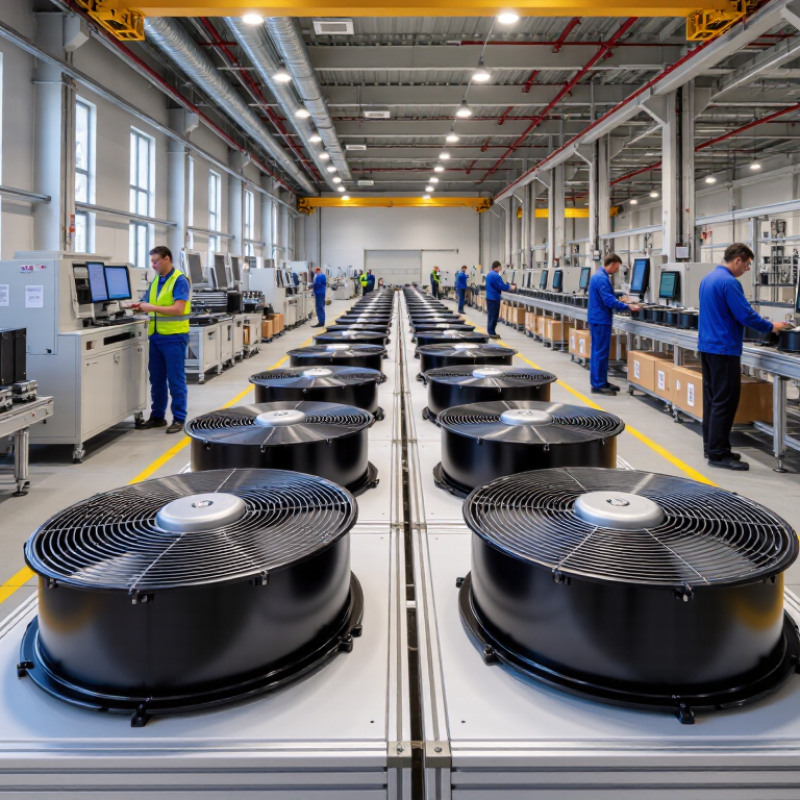
Who Are the Top Car Cooling Fan Manufacturers in China?

What Car Cooling Fans Do in Modern Vehicles

In modern vehicles, electric cooling fans move air through radiators and heat exchangers. At low road speeds, they provide airflow that driving alone cannot. They also help cool the engine and air-conditioning condenser. In many electric vehicles, fans help release heat from battery and power-electronics cooling systems. The IEA’s Global EV Outlook 2024 reports nearly 14 million electric-car sales in 2023, about 18% of global car sales.

Tips: Keep radiator openings clear of leaves and mud. Keep hands clear of electric fans; they can start automatically. A blocked radiator may make the fan work harder.

Fan operation depends on temperature sensors and vehicle controls, so a fan may run briefly after parking. That can be normal. Repeated roaring, weak airflow, or rising temperature calls for inspection. The motor is not always the problem: wiring, relays, debris, or sensor readings can also be involved. Looking only at the fan blades gives an incomplete diagnosis.

Main Types of Automotive Cooling Fans

Automotive cooling fans generally fall into mechanical and electric designs. Mechanical fans draw power from the engine through a belt, often using a temperature-sensitive clutch to reduce drag when cooling demand is low. They remain common in some larger vehicles. Their airflow depends partly on engine speed, which can be a drawback in slow traffic.

Electric fans use a motor to move air through the radiator, and sometimes the air-conditioning condenser.

Not always.

A single fan suits many layouts, while twin fans can serve wider cooling surfaces or separate cooling zones. Axial blades are typical; push-type fans sit ahead of the radiator, while pull-type fans mount behind it. Brushless motors offer precise speed control, but system design matters more than the label.

A poorly matched fan may be noisy or move too little air against a dense radiator. Check airflow, available space, electrical load, shroud fit, and control strategy together. This distinction can get messy: fan type alone cannot predict cooling performance.

How to Evaluate Car Cooling Fan Manufacturers

When evaluating car cooling fan manufacturers in China, look beyond catalog photos and headline airflow figures. Ask how each fan performs against system resistance, not only in an open-air test. A useful supplier can explain the test setup, operating voltage, noise level, and temperature conditions. Details matter.

Check whether the manufacturer can match your vehicle’s dimensions, connector, mounting points, and control signals. Request drawings and a sample for fit checks before discussing large orders. Inspect the blade edges, housing finish, wire protection, and connector seating. Small flaws can signal weak process control. They are not proof, though.

Ask for documented checks on airflow, vibration, electrical load, and endurance. Compare reports across samples, and clarify how rejected parts are handled. A factory visit or live production review may reveal how components are traced and inspected. Also discuss tooling ownership, lead times, and engineering response time in writing. One awkward point: a polished report cannot replace testing in your own cooling system. Run a pilot batch under realistic heat and traffic conditions, then record results before approval.

Profiles of Leading Car Cooling Fan Manufacturers in China

China’s car cooling fan manufacturers include integrated automotive suppliers, specialist motor producers, and export-focused factories. Their strengths differ. Integrated suppliers may offer fan assemblies alongside shrouds, wiring, and temperature controls. Specialist producers often concentrate on motor efficiency, blade balance, and compact packaging. Export-focused factories may support varied connector layouts and custom dimensions, though each option needs careful verification.

A capable manufacturer should explain its airflow and noise testing, operating-temperature range, and durability checks. Ask for test conditions, not just a performance figure. Check whether the fan fits the vehicle’s mounting points and electrical system. A quiet sample on a workbench does not guarantee quiet operation inside a hot engine bay. Details matter. Public profiles rarely reveal every production weakness, so request current inspection records and sample measurements.

Tips: Share the vehicle model, voltage, fan diameter, connector type, and installation space before requesting a quote. Confirm the sample matches the production specification. Compare warranty terms and response times, too; they can reveal more than a polished catalog. One detail is easy to miss: a stronger fan is not automatically the right fan.

How Chinese Manufacturers Compare in Quality and Production Capabilities

Chinese car cooling fan manufacturers differ less by headline capacity than by process control. A large factory may ship thousands of units daily, yet output alone says little about consistency. Ask how each production lot is checked for blade balance, motor current, noise, and airflow. A fan that looks sturdy on a bench can still vibrate after repeated heat cycles. Details matter.

Quality comparisons should include material control, winding accuracy, and endurance testing under realistic temperatures. Capable manufacturers can adjust blade geometry or connectors for a specific vehicle, while keeping samples and production units aligned. Request test records and inspect several units from different batches. One sample is not enough. Honestly, supplier data can be polished; independent testing is useful when the order is important. Smaller producers may offer closer engineering support, but their delivery capacity can be less predictable.

Tips: Share the operating temperature range, mounting dimensions, and electrical requirements before requesting a quote. Compare noise and airflow at the same voltage, not just catalog figures. Ask about inspection frequency and replacement procedures for rejected parts. Then verify the answers with a pilot order.

Who Are the Top Car Cooling Fan Manufacturers in China? - How Chinese Manufacturers Compare in Quality and Production Capabilities
Comparison Dimension Integrated Automotive Supplier Specialist Cooling-Fan Manufacturer General Thermal-Parts Manufacturer Export-Focused OEM/ODM Manufacturer
Typical product scope Cooling modules or fan assemblies, potentially integrated with other vehicle thermal-management components. Electric cooling fans, fan motors, shrouds, or related assemblies. A broader range of thermal parts; fan products may be one product line among several. Customer-specified fan assemblies or components supplied under OEM/ODM arrangements.
Engineering and customization May support vehicle-program engineering, design reviews, and coordinated system integration; confirm scope for each project. May offer focused fan, motor, blade, or shroud design and tuning; verify in-house design and validation resources. Capabilities depend on the fan program; ask whether design changes are developed in-house or sourced externally. Often works to buyer drawings or specifications; establish tooling ownership, design responsibility, and change-control procedures.
Quality-system evidence to check Ask for a current IATF 16949 certificate, its scope and site coverage, plus applicable customer-approval records. Check for IATF 16949 or ISO 9001 certification and confirm that the certified scope covers the relevant manufacturing site and products. Verify the certificate, manufacturing location, product scope, and whether automotive-specific quality requirements are applied to fan production. Confirm applicable certification and request documented inspection, nonconformance, corrective-action, and traceability procedures.
Production and process controls Assess line controls, process-change approval, supplier management, and production traceability for the specific program. Review motor and assembly process controls, end-of-line checks, and controls for critical fan dimensions and balance. Check whether fan production has dedicated process controls and defined inspection plans rather than relying on general plant capability. Assess production planning, lot identification, inspection records, capacity commitments, and controls for subcontracted processes.
Product validation to request Request a product-specific validation plan and reports matched to the vehicle application and customer requirements. Review applicable airflow, electrical, noise, vibration, thermal, and durability test methods and results. Confirm that test facilities, methods, and reports apply to the offered fan assembly and its intended operating conditions. Agree on acceptance criteria and sample-approval testing before production; request test reports linked to the supplied part revision.
Program and supply suitability A potential fit for programs requiring coordinated system supply and automotive program-management processes. A potential fit when fan-specific engineering and production experience are priorities. A potential fit when sourcing several thermal components from one supplier; verify fan-specific expertise. A potential fit for specification-led sourcing; clarify minimum order quantities, lead times, tooling, and after-sales responsibilities.
Useful buyer verification Audit the relevant plant and review program references, process documentation, and sample-to-production controls. Review fan-specific test data, production samples, process capability evidence, and warranty or failure-analysis procedures. Inspect the fan line, confirm accountable engineering contacts, and evaluate product-specific quality records. Validate samples, audit relevant processes, and document specifications, revisions, inspection criteria, and change approvals.
Note: These are supplier archetypes, not named companies or a ranking of Chinese manufacturers. Capabilities vary by factory, product, and program; the descriptions are comparison criteria, not guarantees. Verify current certificates, test reports, production capacity, and customer-specific approvals directly with each supplier.

FAQS

What does a cooling fan do?

It moves air through the radiator and helps cool the engine. It can also cool the air-conditioning condenser and, in many electric vehicles, battery systems.

Why does the fan run when the vehicle is moving slowly?

Slow traffic provides little airflow across the radiator. The fan supplies extra air. A useful little assist.

Can a cooling fan run after parking?

Yes. Temperature sensors and vehicle controls may keep it running briefly. That can be normal, though repeated or unusually long operation deserves a check.

What signs may indicate a cooling problem?

Repeated roaring, weak airflow, or a rising temperature are reasons to inspect the system. The fan motor may not be the cause.

What else can affect fan operation?

Wiring, relays, debris, or incorrect sensor readings can be involved. Looking only at the blades misses important clues.

How do mechanical and electric fans differ?

Mechanical fans draw power from the engine, often through a belt and temperature-sensitive clutch. Electric fans can operate independently of engine speed. Not always simple.

What should be checked when choosing a replacement fan?

Check airflow, available space, electrical load, shroud fit, and control strategy together. A stronger fan is not automatically a better match.

What details should buyers provide when requesting a fan?

Share the vehicle model, voltage, fan diameter, connector type, and installation space. Confirm that the sample matches the production specification; small differences can matter.

Conclusion

Car cooling fans play an essential role in modern vehicles by helping regulate engine temperature and supporting efficient operation, especially when airflow from driving is limited. Depending on the vehicle’s design and cooling requirements, manufacturers may produce different fan types, including electrically powered and mechanically driven models. Choosing the right supplier involves more than comparing prices: buyers can assess product design, materials, manufacturing consistency, testing procedures, production capacity, and after-sales support.

China’s automotive cooling-fan industry includes manufacturers with varied areas of specialization and production strengths. A useful comparison considers how well each maker can meet technical specifications, maintain dependable quality across batches, and adapt to different vehicle applications and order volumes. By examining these factors together, buyers can identify a suitable Car Cooling Fan manufacturer and make a more informed decision based on performance needs, quality expectations, and supply requirements.


Henry

Henry

Henry is a dedicated marketing professional with a profound expertise in the company's offerings. With years of experience in the industry, he possesses an impressive understanding of the market dynamics and consumer behaviors that drive success. Henry is committed to sharing his insights through......