When choosing a Clip Fan, several factors come into play. The right fan can significantly enhance comfort in any space. It's crucial to consider size, power, and design. A compact clip fan can easily secure to various surfaces. This ease of use makes it a versatile option.
Quality is an important aspect. You want a fan that not only operates effectively but also lasts. Researching brands can help you find reliable options. Look for reviews and expert recommendations that highlight durability and performance.
While selecting your fan, think about where you'll use it. Different environments demand different features. For example, a powerful fan might be essential in a hot room. Alternatively, a quieter fan is better for a workspace. Ultimately, your needs will guide your choice, but be open to exploring various options.
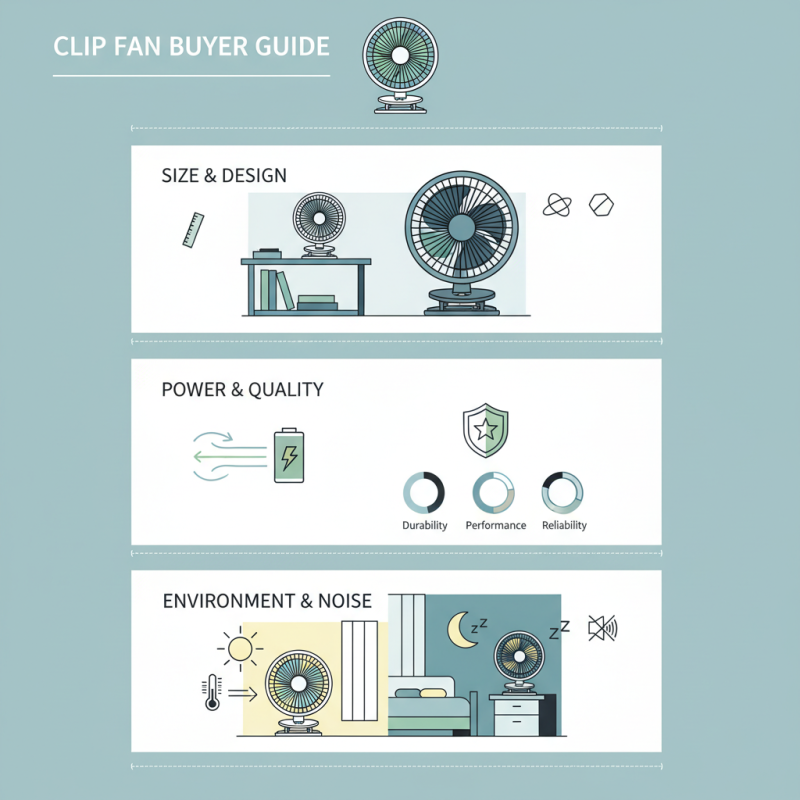
When selecting a clip fan, consider factors that align with your personal needs. One essential aspect is airflow. Reports indicate that fans with an airflow range between 150 to 300 CFM (cubic feet per minute) effectively circulate air in compact spaces. A fan that meets or exceeds this range will provide sufficient cooling.
Noise level is another critical element. According to industry studies, noise levels should ideally be below 50 decibels for personal use. This range ensures that the fan can operate quietly in home or office environments. Users often overlook the importance of noise, but a fan that disrupts your concentration can be counterproductive.
The fan's adjustability can significantly impact your experience. Look for models that offer multiple speed settings and tiltable heads. This feature allows for customized airflow direction. An inflexible fan might limit comfort in varying situations. Lastly, consider battery life if you opt for a rechargeable model. A fan that lasts at least 6 hours on a full charge can be a reliable companion during hot days.
When exploring the variations of clip fans, it's essential to understand key features. Clip fans come in a range of sizes and designs.
Larger models can deliver stronger airflow but may be bulkier.
Smaller fans are portable, making them suitable for tight spaces.
Blade material is another consideration. Some fans have plastic blades, while others use metal.
Metal blades can provide a quiet operation, while plastic folds often create noise.
Speed settings vary as well. Multiple speeds give you control over airflow intensity.
Battery-operated clip fans offer portability, but battery life can be limiting.
In contrast, some models are powered by USB, making them versatile for various environments.
Durability is vital too. Cheaper models may not last, but investing a bit more often yields better quality.
Buyers should always reflect on their specific needs before purchasing a clip fan.
When selecting a clip fan, understanding power and efficiency ratings is essential. These ratings indicate how much energy a fan uses and how effectively it converts that energy into airflow. Look for fans with a high airflow rating relative to their wattage. A fan that moves more air with less power is generally more efficient. However, interpretations of efficiency can vary greatly among different models.
Consider the size of the fan as well. A small fan may consume less power, but if it can’t circulate air effectively in your space, it might not be a practical choice. Check the fan's noise level too. Some models promise high performance but can be uncomfortably loud. Efficiency ratings usually don't reflect noise, so read reviews for real-world experiences.
Always think about your specific needs. Are you using it in a small room or a workspace? What is the average temperature during your usage hours? These questions will influence your decision. Sometimes, the most advertised fan may not be what you need. Reflect on what works best for you, rather than what is popular.
When selecting a clip fan, portability is essential. You need a model that can easily attach to various surfaces. Consider options with a strong grip that can hold on to items like desks, bed frames, or even a stroller. A lightweight design allows for easy transportation from room to room or outside. Look for fans with a compact design that you can effortlessly carry in one hand.
Mounting options further influence usability. Some clip fans come with flexible necks, allowing you to adjust the angle easily. This feature is beneficial for targeting airflow precisely where you want it. A stable mounting system will also prevent the fan from falling, causing potential injury. Check if the clip has rubber padding; it can enhance grip and protect the surfaces you attach it to.
However, not all designs work well universally. Some clips may be too small for thicker surfaces, while others could be cumbersome to adjust. Reflect on your specific needs and the environments where you'll use the fan. Do you require quick adjustments? Or do you prioritize stability? Understanding your priorities helps in selecting the right clip design efficiently.
When selecting a clip fan, understanding noise levels and airflow statistics is crucial for performance and comfort. A quiet fan can enhance your environment, especially in workspaces or bedrooms. According to a 2022 study by the American Society of Heating, Refrigerating and Air-Conditioning Engineers (ASHRAE), fans operating under 30 dB are considered whisper-quiet. Such noise levels prevent distractions while maintaining airflow.
Airflow is measured in cubic feet per minute (CFM). Many efficient clip fans deliver around 300 to 400 CFM. This level ensures adequate cooling while still being relatively quiet. However, power is not everything. A fan with too high a CFM might disrupt the comfort zone, creating a winter-chill effect. Balancing airflow and noise is essential. The comfort threshold for most people lies between 60-70 F. Above that, discomfort grows.
Deciding on the right fan also involves personal preferences and specific needs. Some may prioritize portability over power, or vice versa. Seasoned users recommend testing different models to find the best match. Sometimes, a fan may seem perfect on paper but fails to meet real-life expectations. Thus, examining user reviews and reports is beneficial before making a purchase.
: An airflow between 150 to 300 CFM is effective for compact spaces.
Noise levels should be below 50 decibels for quiet operation, enhancing focus.
Search for adjustable speed settings and tiltable heads for customizable airflow.
A battery life of at least 6 hours is preferred for hot days.
Yes, clip fans come in various sizes, with larger models providing stronger airflow.
Metal blades operate quietly, while plastic blades may create more noise.
Battery-operated fans are portable but may have limited battery life.
Cheaper models might not last, so consider investing in better-quality options.
Yes, USB-powered fans are suitable for different environments depending on the power source.
Many buyers overlook noise levels, which can disrupt concentration during use.
When selecting the best clip fan for personal use, several key factors should be taken into account. These include the various types of clip fans available, which come with different features suited for various needs. Understanding power and efficiency ratings is crucial for ensuring optimal performance, while portability and mounting options can greatly affect the fan's usability in different environments.
Additionally, it's important to consider noise levels and airflow statistics, striking a balance between effective cooling and comfort. By evaluating these aspects, you can find a clip fan that fits your requirements, ensuring you stay refreshed during warm days without sacrificing convenience or peace.

Yate Auto